Showing posts with label storage. Show all posts

Preserves - Food prepared for long term storage

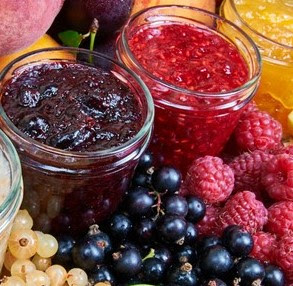
Preserves are fruits, or vegetables, that have been prepared and canned for long term storage. Preserves are foods with many textures, flavors, and colors. They all consist of fruits preserved mostly by means of sugar and they are thickened or jellied to some extent.

Preserves are made of small, whole fruits, or uniform-size pieces of fruits in a clear, thick, slightly jellied syrup. The fruit should be tender and plump.

The preparation of fruit preserves traditionally involves the use of pectin as a gelling agent, although sugar or honey may be used as well. The ingredients used and how they are prepared will determine the type of preserves; jams, jellies and marmalades are all examples of different styles of fruit preserves that vary based upon the ingredients used.

Fruit provides the characteristic color, flavor and at least part of the acid and pectin needed for successful gels. Flavorful fruit varieties are best for any type of fruit preserve.

Sugar helps in gel formation, serves as a preserving agent, and contributes to the flavor of the jellied product.

Pectins are substances in fruits that form a gel if they are in the right combination with acid and sugar. All fruits contain some pectin. It is naturally occurring and found in many fruits, some containing enough natural pectin to make finished product. Apples, crab apples, gooseberries, and some plums and grapes usually contain enough natural pectin to form a gel.

Pectins are complex chemicals whose jelling ability is standardized in products made for use in preserves. Preserves get their smooth, semisolid consistency from pectin. Pectin is a generic term for numerous pectinic acids. Commercial pectin is extracted from apple cores or the white layer of citrus fruit. Commercial pectins contain added acid to ensure jelling.

However, the ability of these products to jell is gradually lost if stored too long before use, or if the mix is heated too long before it is filled into jars.

No-cook preserves must be stored in the freezer until use. After opening, they can be stored in the refrigerator up to 3 weeks. Preserves can add zest to meals, and provide a good way to use fruits not suitable for canning or freezing.
Preserves -  Food prepared for long term storage
Read more...

Storage of salted fish

Fish has been salted for centuries as a way to preserved it. In the days of the Atlantic slave trade, the slave price was paid in Spanish coins, or salted fish.

Salted fish was also used to feed the slaves on the Middle Passage. Salted fish are obtained by salting fresh, deep frozen or frozen fish. Salted products include: herring, anchovies, saithe, cod salmon, tuna and roe or caviar.

Storage of salted products depends on salt concentration, moisture content and temperature. Storage life may be up to 1-2 years under certain conditions.

Salt cod, which has moisture content of 40% or higher should be held at temperatures of 40 °F (4.4 °C) or slightly below since it is subject to spoilage through bacterial growth.

On the other hand, well-dried salt cod and certain types of salted and smoke herring (which have dried during smoking) may be held at room temperatures without spoilage.
Storage of salted fish

Read more...

Storage and fumigation of grapes

Grapes are highly perishable in nature. Therefore they cannot be stored for a long period or transported long distanced at ambient temperatures.

Grapes to be shipped as fresh are packed in wooden crates, then pre-cooled to about 40 ° F (4.4 °C) in railroad cars or refrigerated rooms.

The fruit can tolerate temperatures slightly lower than this, but the margin of safety above freezing the grapes becomes so narrow that for practical purposes, this temperature should he considered the minimum.

Generally, the grapes will be fumigated with sulfur dioxide prior to or during cooling to prevent mold growth. Sulfur fumigation after harvest and /or used of grapes guards have been shown to reduce postharvest losses significantly. The fungus may infect berries in vineyards, particularly when extended periods of rainy weather occur before harvest.

Sulfur dioxide is produced by burning elemental sulfur. It is lightly toxic to fungi and bacteria. The toxicity increases with the percent relative humidity.  The relative humidity of the air should be as high as practicable – 95% if possible.

Grapes that are to be stored for future shipment should be packed in crates, pre-cooled to 36-40 °F (2.2 - 4.4 °C), place in refrigerated storage 29- 32 ° F (-1.67 – 0 °F), and fumigated with sulfur dioxide and should be held in this manner until shipped.

Periodic re-fumigation with sulfur dioxide may be required to prevent spoilage by molds.
Storage and fumigation of grapes  


Read more...

Storing food in refrigerator


Foods maintains their quality, safety, and nutrients when they’re stored properly and used within a certain time.

In the freezer food should be stored at -18° C. The freezer temperature can be monitored with a freezer thermometer.

The refrigerator should operate at 5° C or below. Perishable food should be kept cool at 8° C.

30 percent of the cold air inside lose out when open the door. If not too many items in refrigerator, place an approximately sized closed food storage container in the empty place. When open the door, the cool air in the food storage container remains in the refrigerator.

Use a refrigerator thermometer to measure the temperature and insert a food probe into the food to measure the food temperature.

Keep the refrigerator full but not cluttered. The refrigerator should be an equal temperature in all areas. However, do not overload the refrigerator. Need enough space between food containers to ensure that air can circulate freely.

All stored foods should be wrapped or in covered container. Seal storage containers well to prevent moisture loss and absorption of off-odors. Unless the package is torn, leave food in its store wrapping.
Storing food in refrigerator

Read more...

The Most Popular Articles

RSS Food Processing

Hypertension and Diet

Processing of Food

Food Science and Human Nutrition

  © Blogger templates Newspaper by Ourblogtemplates.com 2008

Back to TOP